
Problem Set 2#
Problem 1 (40 points evenly divided)#
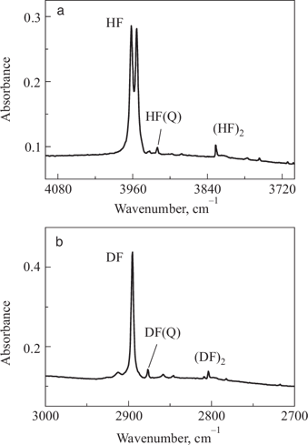
The fundamental absorption feature of hydrogen fluoride (HF) occurs at
\(\bar{\nu} = 3960 \ \text{cm}^{-1}\) (see Figure 1), where the wavenumber \(\bar{\nu}\) is related to the frequency \(\nu\) by:
where \(c\) is the speed of light (\(2.99 \times 10^{10} \ \text{cm/s}\)).
Assuming the Harmonic Oscillator is a good model for the vibrational motion of HF, we can relate this IR absorbance peak to the force constant and reduced mass of HF as follows:
Figure 1: IR Spectra of hydrogen fluoride (HF, top) and deuterium fluoride (DF, bottom)
(a) Compute the reduced mass:
\[ \mu = \frac{m_H \cdot m_F}{m_H + m_F} \]Use SI units.
Answer:
(b) Using \(\bar{\nu} = 3960 \ \text{cm}^{-1}\) and the reduced mass calculated in part (a), compute the force constant \(k\) for the HF bond. Express your answer in SI units.
Answer:
(c) The reduced mass of deuterium fluoride (DF) can be calculated using:
\[ \mu = \frac{m_D \cdot m_F}{m_D + m_F} \]Can the change in reduced mass alone account for the fundamental absorption of DF occurring at
\(2900 \ \text{cm}^{-1}\) as compared to \(3960 \ \text{cm}^{-1}\) for HF?
Explain your reasoning and provide any calculations to support your answer.
Answer: