

Chapter 1: Introduction to Quantum Phenomena#
Prof. Jay Foley, UNC Charlotte, and Prof. Eugene DePrince, Florida State University
Multiple Stern-Gerlach Apparatus Experiments#
The Stern-Gerlach experiment is a canonical experiment in the intellectual history of quantum mechanics that encapsulates the majority of these concepts and topics (1–8). In many presentations within the undergraduate chemistry curriculum, the Stern-Gerlach experiment is presented in the context of the intrinsic quantized spin of the electron. A reenactment of the original experiment with fun and insightful discussion of the role of sulfur-rich cheap cigars favored by Stern has been provided by Friedrich and Herschbach and is worth mentioning to liven the discussion of the 1922 result (7).
While the discovery of the quantization of spin is certainly a significant outcome of the Stern-Gerlach experiment, the experiment also provides a beautiful illustration of quantum measurement that can be generalized to any quantum mechanical observable. Sometimes, this experiment is introduced in a style inspired by David Albert’s “Quantum Mechanics and Experience” (5) where the components of spin are given the nicknames of “color” and “hardness” – this helps to prevent students from making assumptions about the properties based on their knowledge of spin from general chemistry, etc. Here, we will make explicit reference to spin, and will subsequently introduce the formalism of spin 1/2 as our first model quantum system.
The Multiple Apparatus Experiment#
In this version of the experiment, we consider the measurement of different components of electron spin using multiple Stern-Gerlach apparatus arranged in sequence. A large number of electrons are prepared in identical quantum states and sent through apparatus that measure either the z-component of spin (Sz) or the x-component of spin (Sx).
Apparatus Setup#
z-component measurement apparatus: Has a single in-port and two out-ports – one out-port for spin-up in the z-direction (↑z or \(+ \hbar / 2\)) and one out-port for spin-down in the z-direction (↓z or \(- \hbar/2\))
x-component measurement apparatus: Has a single in-port and two out-ports – one out-port for spin-up in the x-direction (↑x or \(+ \hbar / 2\)) and one out-port for spin-down in the x-direction (↓x or \(- \hbar / 2\))
Sequential Experiments#
Initial Measurements#
A series of experiments are described where 1000 identically prepared electrons are sent through the z-component apparatus, with half emerging through the ↑z port and half through the ↓z port. Similarly, when 1000 electrons are sent through the x-component apparatus, half emerge through the ↑x port and half through the ↓x port.
Experiment 1: Persistence of z-component#
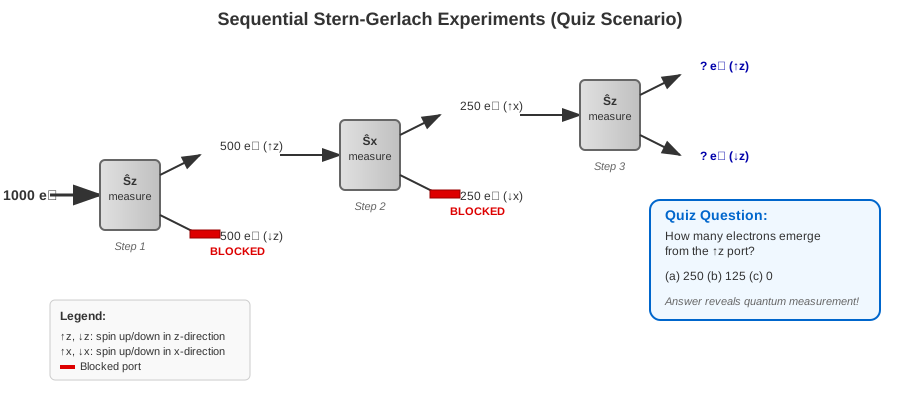
1000 electrons are sent through the z-component apparatus with the ↓z port blocked and the ↑z port aligned such that the 500 spin-up-z electrons enter a second z-component apparatus. Of these 500 electrons, all 500 emerge from the ↑z port of the second apparatus. Based on this first elaboration, the z-component of spin seems to be a persistent property once measured.
Experiment 2: z and x components are incompatible observables#
1000 electrons are sent through the z-component apparatus with the ↓z port blocked and the ↑z port aligned such that the 500 spin-up-z electrons enter an x-component apparatus. Of these 500 electrons, 250 emerge from the ↑x port and 250 emerge from the ↓x port. Based on this second elaboration, the z- and x-components of spin do not seem to be correlated – knowing the z-component tells us nothing about the x-component.
Experiment 3: The quantum measurement puzzle#
The third elaboration adds one more step onto the second elaboration by blocking the ↓x port of the x-component apparatus and aligning its ↑x port such that the 250 electrons that emerged from it enter a second z-component apparatus (see Figure 1).
Quiz time: How many electrons emerge from the ↑z port of the second z-component apparatus?
(a) 250 (all of them)
(b) 125 (half of them)
(c) 0 (none of them)
This experimental sequence illustrates the key quantum mechanical concepts of measurement, superposition, and the uncertainty principle as applied to the intrinsic angular momentum (spin) of electrons.
The Postulates of Quantum Mechanics#
The behavior of quantum mechanical systems is governed by a set of fundamental postulates that provide the mathematical framework for understanding and predicting quantum phenomena. Here we present these postulates in the context of spin 1/2 systems, using the electron spin as our primary example.
Postulate 1: The Quantum State#
The state of a quantum mechanical system is completely described by a wavefunction.
For spin 1/2 systems, any wavefunction can be represented as a vector with 2 complex numbers, corresponding to the amplitudes for the two possible spin states along a chosen axis (typically the z-axis).
Examples:#
Spin-up along z-axis:
Spin-down along z-axis:
General spin 1/2 state:
where \(a\) and \(b\) are complex numbers called probability amplitudes, and the normalization condition requires \(|a|^2 + |b|^2 = 1\).
Note on some common conventions: Chemists will often refer to electrons with spin-up along z as \(\alpha\) electrons, and electrons with spin-down along z as \(\beta\) electrons. In that case, we might refer to the quantum states as
and
Near the end of the term, we will hopefully discuss quantum information science and the concepts of qubits, for which the formalism of spin 1/2 plays an important role. In that context, the state with spin-up along z is typically denoted \(|0\rangle\) and the state with spin-down along z is typically denoted \(|1\rangle\). So, let’s keep in mind that we might see the following labels used interchangeably in our careers!
and
It is often frustrating to students that there are many different conventions used in quantum mechanics (actually, this isn’t unique to quantum mechanics). While we will try to use consistent notation, it is also important to understand the abstraction inherent in how we talk about quantum mechanics and express problems and situations in mathematical language. What we can reliably do when talking about some quantum system is describe its properties and different rules that it obeys, and if you as a student can think clearly about these properties and rules, differences in notation will be much less troubling.
Postulate 2: Observables and Operators#
Every observable quantity has a corresponding Hermitian operator.
For spin 1/2 systems, operators can be represented as 2×2 matrices. The spin operators are constructed using the Pauli matrices (discussed more in the next section).
Example: The \(\hat{S}_z\) operator#
The z-component of spin angular momentum operator is:
where \(\sigma_z\) is the Pauli z-matrix and \(\hbar\) is the reduced Planck constant.
The Reduced Planck Constant (\(\hbar\))
The quantity \(\hbar\) (pronounced “h-bar”) is fundamental to quantum mechanics and appears throughout these postulates. It is defined as: \(\hbar = \frac{h}{2\pi} = 1.055 \times 10^{-34} \text{ J⋅s}\) where \(h\) is Planck’s constant. Important note about dimensions: \(\hbar\) is a dimensionful quantity with dimensions that can be expressed equivalently as:
Energy × Time: [J⋅s]
Action: [J⋅s] (the classical physics quantity “action”)
Angular momentum: [kg⋅m²⋅s⁻¹]
All three representations are dimensionally equivalent and highlight different physical contexts where \(\hbar\) appears. In spin systems, we often think of \(\hbar\) in terms of angular momentum, since spin is intrinsic angular momentum. The tiny magnitude of \(\hbar\) explains why quantum effects are typically only observable at atomic and subatomic scales.
Postulate 3: Measurement Outcomes#
The only possible results of measuring an observable are the eigenvalues of the corresponding operator.
There exist special quantum states called eigenstates, which have well-defined values of an observable. These states satisfy the eigenvalue equation:
where \(\hat{A}\) is the operator, \(|\psi_n\rangle\) is an eigenstate, and \(a_n\) is the corresponding eigenvalue.
Example: Eigenstates of \(\hat{S}_z\)#
Practice
Let’s confirm that the vector representations of states \(|\uparrow_z\rangle\) and \(|\downarrow_z\rangle\) satisfy these eigenvalue equations using the matrix representation of \(\hat{S}_z\).
Question 1
\[\begin{split}\begin{align} \hat{S}_z |\uparrow_z\rangle = \frac{\hbar}{2}\begin{pmatrix} 1 & 0 \\ 0 & -1 \end{pmatrix} \begin{pmatrix} 1 \\ 0 \end{pmatrix} = \,? \end{align}\end{split}\]Answer 1
Well,\[\begin{split}\begin{align} \hat{S}_z |\uparrow_z\rangle &= \frac{\hbar}{2}\begin{pmatrix} 1 & 0 \\ 0 & -1 \end{pmatrix} \begin{pmatrix} 1 \\ 0 \end{pmatrix} \\[0.5em] &= \frac{\hbar}{2}\begin{pmatrix} (1)(1) + (0)(0) \\ (0)(1) + (-1)(0) \end{pmatrix} \\[0.5em] &= \frac{\hbar}{2}\begin{pmatrix} 1 \\ 0 \end{pmatrix} \\[0.5em] &= +\frac{\hbar}{2} \begin{pmatrix} 1 \\ 0 \end{pmatrix} \\[0.5em] &= +\frac{\hbar}{2} |\uparrow_z\rangle \end{align}\end{split}\]So, yes, \(|\uparrow_z\rangle\) is an eigenvector of the matrix representation of \(\hat{S}_z\) with eigenvalue \(+\hbar / 2\).
Question 3
Consider the superposition \(|\psi\rangle = \frac{1}{\sqrt{5}}|\uparrow_z\rangle + \frac{2}{\sqrt{5}} |\downarrow_z\rangle\), what is the probability of measuring \(\hbar/2\) for \(S_z\)? What is the probability of measuring \(-\hbar/2\) for \(S_z\)?
Answer 3/summary>
Well,
\[\begin{split}\begin{align} P(+\hbar/2) = |\frac{1}{\sqrt{5}}|^2 = \frac{1}{5} \\ P(-\hbar/2) = |\frac{2}{\sqrt{5}}|^2 = \frac{4}{5} \\ \end{align}\end{split}\]
Question 2
\[\begin{split}\begin{align} \hat{S}_z |\downarrow_z\rangle = \frac{\hbar}{2}\begin{pmatrix} 1 & 0 \\ 0 & -1 \end{pmatrix} \begin{pmatrix} 0 \\ 1 \end{pmatrix} = \,? \end{align}\end{split}\]Answer 2
Well,
\[\begin{split}\begin{align} \hat{S}_z |\downarrow_z\rangle &= \frac{\hbar}{2}\begin{pmatrix} 1 & 0 \\ 0 & -1 \end{pmatrix} \begin{pmatrix} 0 \\ 1 \end{pmatrix} \\[0.5em] &= \frac{\hbar}{2}\begin{pmatrix} (1)(0) + (0)(1) \\ (0)(0) + (-1)(1) \end{pmatrix} \\[0.5em] &= \frac{\hbar}{2}\begin{pmatrix} 0 \\ -1 \end{pmatrix} \\[0.5em] &= -\frac{\hbar}{2} \begin{pmatrix} 0 \\ 1 \end{pmatrix} \\[0.5em] &= -\frac{\hbar}{2} |\downarrow_z\rangle \end{align}\end{split}\]So, yes, \(|\downarrow_z\rangle\) is an eigenvector of the matrix representation of \(\hat{S}_z\) with eigenvalue \(-\hbar / 2\).
Probabilistic Nature of Measurements#
Not all quantum states are eigenstates of a given observable. For superposition states, measurement outcomes are probabilistic. Consider a general superposition:
When measuring \(S_z\):
Probability of obtaining \(+\hbar/2\): \(|a|^2\)
Probability of obtaining \(-\hbar/2\): \(|b|^2\)
The probabilities are given by the norm squared of each coefficient in the superposition.
Postulate 4: Completeness of Eigenfunctions#
The eigenfunctions of any observable form a complete set.
Any spin 1/2 state can be expressed as a linear combination of the eigenstates of \(\hat{S}_z\) (or any other spin component), because these eigenstates form a complete basis set.
Expansion in the \(S_z\) Basis#
Any spin state, whether it’s an eigenstate of \(\hat{S}_x\), \(\hat{S}_y\), \(\hat{S}_z\), or some other combination, can be written as:
Computing Expansion Coefficients#
The coefficients can be found using the inner product (bra-ket notation):
Example: For the \(+x\) eigenstate \(|\uparrow_x\rangle = \frac{1}{\sqrt{2}}\begin{pmatrix} 1 \\ 1 \end{pmatrix}\):
Bra-Ket Notation Let’s clarify the notation we’re using:
A ket \(|\psi\rangle\) represents a quantum state as a column vector A bra \(\langle\psi|\) represents the adjoint (complex conjugate transpose) of the ket as a row vector The bra-ket \(\langle\phi|\psi\rangle\) is the inner product between two states, computed as the matrix product of a row vector and a column vector, yielding a scalar
For real-valued coefficients (as in our last example), the adjoint operation simply transposes the vector. For example: \(|\uparrow_z\rangle = \begin{pmatrix} 1 \\ 0 \end{pmatrix} \quad \Rightarrow \quad \langle\uparrow_z| = \begin{pmatrix} 1 & 0 \end{pmatrix}\)
For a general state
\(|\psi\rangle = \begin{pmatrix} a \\ b \end{pmatrix} \quad \Rightarrow \quad \langle\psi| = \begin{pmatrix} a^* & b^* \end{pmatrix}\)
where \(a^*\) is the complex conjugate of \(a\) and \(b^*\) is the complex conjugate of \(b\). For any complex number, we may always express it as a real part plus an imaginary part:
where \(i = \sqrt{-1}\).
The complex conjugate of \(z\) simply results from taking the negative of the imaginary component:
Postulate 5: Expectation Values#
The expectation value of an observable is given by the quantum mechanical average.
For an arbitrary state \(|\psi\rangle\) and observable \(\hat{A}\):
Example: Expectation value of \(\hat{S}_z\)#
For a superposition state \(|\psi\rangle = a|\uparrow_z\rangle + b|\downarrow_z\rangle\):
Physical Interpretation#
The expectation value represents the predicted average result of a large number of independent measurements of the observable performed on identically prepared quantum systems. It does not necessarily correspond to any single measurement outcome, but rather to the statistical average over many measurements.
Postulate 6: Time Evolution#
The time evolution of a quantum system is governed by the time-dependent Schrödinger equation:
where \(\hat{H}\) is the Hamiltonian operator, which represents the total energy of the system.
Time Evolution and Unobserved Systems#
This equation describes how quantum states evolve when they are not being measured. The time evolution is deterministic and unitary, preserving the normalization of the wavefunction.
Note: We have not yet introduced the Hamiltonian operator in detail for spin systems. We will explore time evolution more thoroughly when we discuss our next model system: the particle in a box, where the Hamiltonian has a more familiar form involving kinetic and potential energy terms.
Summary#
These six postulates provide the complete mathematical framework for quantum mechanics. They connect the abstract mathematical formalism (wavefunctions, operators, eigenvalues) to physical observations (measurement outcomes, probabilities, time evolution). The Stern-Gerlach experiments we discussed earlier provide beautiful experimental demonstrations of these postulates in action, particularly showing how measurements of non-commuting observables (like \(\hat{S}_z\) and \(\hat{S}_x\)) lead to the probabilistic nature of quantum mechanics.
Spin Angular Momentum#
Spin angular momentum is an intrinsic property of microscopic particles, like their mass and charge. The concept of spin emerges in Dirac’s relativistic extension of the Schrödinger equation. In non-relativistic quantum mechanics, spin is incorporated into a wave function because we know, from experiment, that quantum particles possess this property. Fundamental particles can be chategorized in one of two ways, based on their spin. Fermions have half-integer spin; for example, electrons are fermions with a spin quantum number, \(s = \frac{1}{2}.\) Bosons have integer spin; for example, photons are bosons with \(s = 1.\)
Let us consider the spin of an electron, which is a fermion. All electrons have \(s = \frac{1}{2},\) which determins the magnitude of the spin angular momentum, \(s(s+1)\hbar^2 = \frac{3}{4}\hbar^2.\) From general chemistry, we learn that electrons can have \(\alpha\) or \(\beta\) spin, and we also refer to these electrons has having spin up or down. The terms “up” and “down” refer to the \(z\) projection of the spin angular momentum, \(m_s \hbar\), as we just saw in the Stern-Gerlach experiment. From the analysis in the previous section, we know \(m_s\) for an electron can take on two values. \(\alpha\) spin electrons have \(m_s = + \frac{1}{2},\) while \(\beta\) spin electrons have \(m_s = - \frac{1}{2}.\)
The operators for spin angular momentum are analogous to those we considered above for orbital angular momentum. We have
These operators have the same commutator properties as we derived above for orbital angular momentum, so
Mathematically, we represent spin operators as
where \(\sigma_x,\) \(\sigma_y,\) and \(\sigma_z\) are \(2 \times 2\) Hermitian matrices called “Pauli spin matrices” and are defined by
As we already saw, the spin state of an electron can then be represented as a two-component vector quantity. We reiterate this here and also introduce the \(|\alpha\rangle\) and \(|\beta\rangle\) notation that might be reminiscent of general chemistry and is also used fairly commonly in other contexts!
Are \(|\alpha\rangle\) and \(|\beta \rangle\) eigenfunctions (or eigenvectors) of the spin matrices? For \(\hat{S}_x,\) we have
For \(\hat{S}_y,\) we have
For \(\hat{S}_z,\) we have
So, \(|\alpha\rangle\) and \(|\beta\rangle\) are not eigenfunctions of \(\hat{S}_x\) or \(\hat{S}_y,\) but they are eigenfunctions of \(\hat{S}_z,\) with eigenvalues equal to \(\frac{\hbar}{2}\) and \(-\frac{\hbar}{2},\) respectively.
Are \(|\alpha\rangle\) and \(|\beta\rangle\) are eigenfunctions of \(\hat{S}^2\)? We have
and, similarly,
So, both \(|\alpha\rangle\) and \(|\beta\rangle\) are eigenfunctions of \(\hat{S}^2\), with eigenvalue \(\frac{3\hbar^2}{4}.\)
Lastly, note that a general spin function for an electron could be a linear combination of the \(|\alpha\rangle\) and \(|\beta\rangle\) spin functions, i.e.,
where \(c_1\) and \(c_2\) are probability amplitudes whose square moduli are the respective probabilities that the electron would be found to have either spin up or down, if this property was measured.
Practice
Question 11.
Show that $\(\begin{align}[\hat{S}^2, \hat{S}_x] &= 0 \\ [\hat{S}^2, \hat{S}_y] &= 0 \\ [\hat{S}^2, \hat{S}_z] &= 0 \\ [\hat{S}_x, \hat{S}_y] &= i\hbar \hat{S}_z \\ [\hat{S}_z, \hat{S}_x] &= i\hbar \hat{S}_y \\ [\hat{S}_y, \hat{S}_z] &= i\hbar \hat{S}_x \\ \end{align}\)$
Question 12.
Find spin eigenfunctions of \(\hat{S}_x\) and \(\hat{S}_y.\) Are these eigenfunctions also eigenfunctions of \(\hat{S}^2\)?
Question 13.
Consider rasing and lowering spin operators
\[\begin{split}\begin{align} \hat{S}_\pm &= \hat{S}_x \pm i\hat{S}_y \\ \end{align}\end{split}\]Show that $\(\begin{align} \hat{S}_+|\alpha\rangle &= 0 \\ \hat{S}_+|\beta\rangle &= \hbar|\alpha\rangle \\ \hat{S}_-|\alpha\rangle &= \hbar|\beta\rangle \\ \hat{S}_-|\beta\rangle &= 0 \end{align}\)$
Practice Problems#
Question 11
Show that
Show Solution
We need to show the commutation relations of spin operators.
and
This follows from the algebra of angular momentum operators and
\(\hat{S}^2 = \hat{S}_x^2 + \hat{S}_y^2 + \hat{S}_z^2\).
Question 12
Find spin eigenfunctions of \(\hat{S}_x\) and \(\hat{S}_y\).
Are these eigenfunctions also eigenfunctions of \(\hat{S}^2\)?
Show Solution
Eigenfunctions of \(\hat{S}_x\):
$\( \tfrac{1}{\sqrt{2}}(|\alpha\rangle \pm |\beta\rangle) \)$Eigenfunctions of \(\hat{S}_y\):
$\( \tfrac{1}{\sqrt{2}}(|\alpha\rangle \pm i|\beta\rangle) \)$All of these are also eigenfunctions of \(\hat{S}^2\), since
\(\hat{S}^2\) commutes with every component of \(\hat{S}\).
Question 13
Consider raising and lowering spin operators
Show that
Show Solution
The raising and lowering operators are defined as
Their action on spin states:
This follows from the matrix representations of \(\hat{S}_x\) and \(\hat{S}_y\).
Computational Notebook#
References#
Gerlach, W.; Stern, O. Der Experimentelle Nachweis des Magnetischen Moments des Silberatoms. Z. Phys. 1921, 8, 110–111.
Gerlach, W.; Stern, O. Der Experimentelle Nachweis der Richtungsquantelung im Magnetfeld. Z. Phys. 1922, 9, 349–352.
Platt, D. E. A Modern Analysis of the Stern-Gerlach Experiment. Am. J. Phys. 1992, 60, 306–308.
Gondran, M.; Gondran, A. Measurement in the de Broglie-Bohm Interpretation: Double-slit, Stern-Gerlach, and EPR-B. Phys. Res. Int. 2014, 14, 1.
Albert, D. Z. Quantum Mechanics and Experience. First Harvard University Press (1992)
Courtney, W. F.; Viera, L. B.; Julienne, P. S.; Kreericks, J. F. Incorporating the Stern-Gerlach Experiment into the Undergraduate Quantum Mechanics Curriculum. Am. J. Phys. 2020, 88, 298
Friedrich, B.; Herschbach, D. Stern and Gerlach: How a Bad Cigar Helped Reorient Atomic Physics. Phys. T oday 2003, 56, 53–59.
Corcovilos, T. A. A Simple Game Simulating Quantum Measurements of Quibits. Am. J. Phys. 2018, 86, 510.